
“Come sta?” I’d ask.
In response, Tony would reply “Bene!”
Other than this question, I knew no Italian and he knew no English. Nevertheless, over the span of six years, we had developed a bond, born of ritual.
The Familiar Faces That Make Rochester Feel Like Home
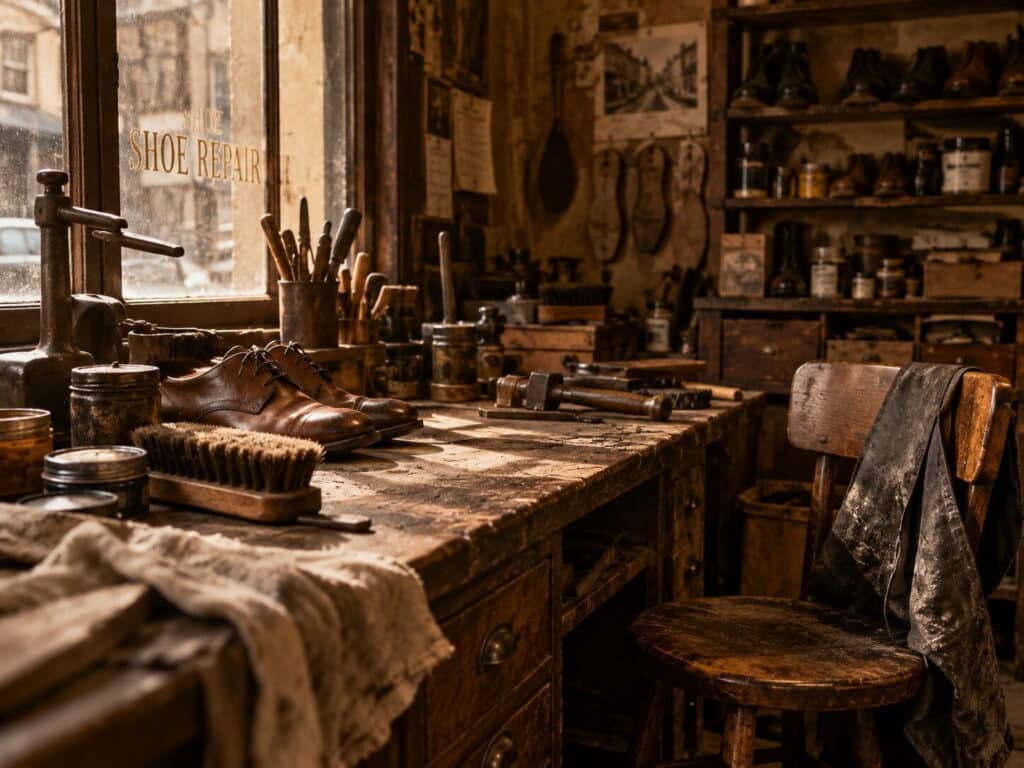
I was driving down Upper Monroe the other day and, for the first time in a while, Tony, the congenial shoe repairman, came to mind. He had a small shop in that stretch of the city and, as I drove by, I could envision him perfectly. He stood no more than five feet tall with thinning white hair and thick glasses. He wore an apron that was soiled with the polish used in making his clients look businesslike and dapper. I imagined by his slight girth that he was happily married and his posture spoke to the weight of the many years he spent bent over his cobbler’s table, scratching out a meager living. Tony was warm and kind and he had a twinkle in his eye. And, nobody would have been surprised to learn that, behind the brushes, cloths, and buffing wheel, hid another workshop where, in his spare time, he was carving a puppet that would someday become a boy.
I would stop in every once in a while to drop off a pair of shoes that needed his attention. A week after each visit, knowing that I could never remember how to spell his last name, he would hand me a small slip of paper on which it was neatly printed. I would write a check, he would hand me my now-shiny footwear and, a few weeks later, I would stop in and we would recommence our neatly practiced two-step.
The Everyday Relationships That Connect a Neighborhood
Five minutes north, on East Avenue, Bob works at the Sunoco station, and he is sunshine come to life. His brand of happy is so infectious that I would drive a mile or two out of my way simply to enjoy the privilege of having him fill my tank. There’s something about him that is best described as paternal. Odd that I should feel this way toward another man my age. However, if I ever had a flat tire or a concern with my car, I took comfort in knowing that Bob would be there to take care of things.
A few years ago Bob went missing. Curious, I asked one of his co-workers where he had been and, in confidence, I was told that Bob was seriously ill and would probably not be returning to work. I was devastated. Like Tony, I didn’t know his last name or where he lived. I assumed that he had a wife but I wasn’t sure if he liked the Bills or enjoyed lager over an IPA. What I did know was that I felt a love for him that I thought I had reserved for close friends.
In his absence, my trips to the station became less frequent. A year and a half later, running low on fuel, I pulled into the station and, like Lazarus, there he was. Bob had returned, cheerful as ever. A full tank later I pulled away, grateful for small miracles.
Why Community Matters in an Increasingly Isolated World
As Sesame Street taught me, these are “the people in my neighborhood.” Increasingly, in a world in which algorithms and bot farms are fomenting division, men and women like Tony and Bob may be playing a role in our lives more important than we realize.
In 2000, Robert Putnam published his seminal work, Bowling Alone. In it, he describes the decline of the social networks and relationships that sustain civic and community life. It’s this dissolution of social engagement that threatens psychological vitality while simultaneously weakening democratic societies.
Derek Thompson’s essay The Anti-Social Century, published in January 2025, is, in many ways, a companion piece to Putnam’s earlier work. He describes our modern society as one that revolves around bingeing the latest Netflix drama or falling prey to the outrage-industrial complex- all from within the cocoon of our increasingly comfortable homes. It’s hard to commit oneself to meaningful social engagement when the inertia of domestic serenity locks us in place.
And that’s where the “people in our neighborhood” come in. Before we know their politics or their religion, before we’re encouraged to hate them because of their differences, we grow to enjoy them and that which they bring into our lives. As the fabric of American society struggles to remain intact, they may actually provide the stitching that prevents the quilt from fraying completely.
In the early summer of 2020, as the first wave of COVID began to slowly abate, I found that my shoes still carried the stain of a long and difficult winter. From the passenger seat of my car, I grabbed the brown bag containing my loafers and headed to the door of Tony’s shop, anxious to greet him in his native tongue. As I reached for the door handle, I realized that the accordion gate was padlocked. In the windowpane of the door, on a piece of paper torn from a spiral notebook, was a single word written in unfamiliar handwriting and perfect English: “Closed.”