
Several times a week, before fully diving into my day, I approach our Peloton, twiddle a few buttons, and find an appropriate workout. Most mornings, I’m pedaling my way to better health by choosing to spin with my favorite drill sergeant, Tunde Oyeneye. I jump on the bike, clip in, and push hard. Really hard. Then, suddenly… Holy hell- how am I possibly going to make it through the final third of this class? Sure, I finish, however, it’s not with the same vigor and intensity that I had brought to my very optimistic beginning. As I’ve repeatedly come to realize, no one can sprint indefinitely at the same pace…
Nobody who experienced the fervor of the Rochester real estate market in May of 2020 could have imagined that all of that frenzied activity was only Mile One of what would become a six year marathon. Along the route, as property values increased more than 75%, homeowners, buyers, sellers, and brokers collectively wondered, how strong is this market? Will it ever end and, if so, when? Well, it’s too early to definitively state that the seller’s market has come to an end, however, anecdotal evidence points to the fact that, at least for the moment, it has lost some strength.
One of the clearest metrics for measuring market strength has been DOM- Days on Market. For several years, Rochester has been heralded by major real estate journals as one of the best markets in the country based, in part, on this number. A house would traditionally be listed for sale on a Thursday and, by Tuesday, it would be sold- often with multiple offers.
In early May, online realtor forums were suddenly populated by distressed agents, panicked by properties that had “survived delayed negotiation”. Water cooler conversations centered around the paucity of showings leading up to an Open House- and the few buyers who actually attended the Open House. Agents started reaching out to colleagues, inviting them to Broker Opens- a marketing vestige from the days of fax machines.
In conversation with their clients, realtors began to hear a litany of concerns that were grounded in real world realities.
Although they’ve recently fallen to 6.53%, mortgage rates rose as high as 6.75% in the months after the war with Iran began.
Consumer sentiment improved modestly in June from May’s record low, but it remains deeply depressed. The University of Michigan Consumer Sentiment Index registered 49.5 in June, down from 60.7 during the same month last year, a decline of nearly 19%.
The May CPI report shows that inflation continues to rise, reaching 4.2%, largely because of a surge in energy costs. This was the highest level since April 2023, with energy prices rising 3.9% during the month and marking the third consecutive monthly acceleration.
Although not tied to any concrete data, buyers have expressed concern around recent geopolitical turmoil, energy shocks, and domestic unrest.
While there seems to be continued interest on the part of many buyers to purchase a home, the collective impact of these negative forces is causing many buyers to be more selective. Others are, at least temporarily, taking a step back, waiting for a more propitious moment to resume their search.
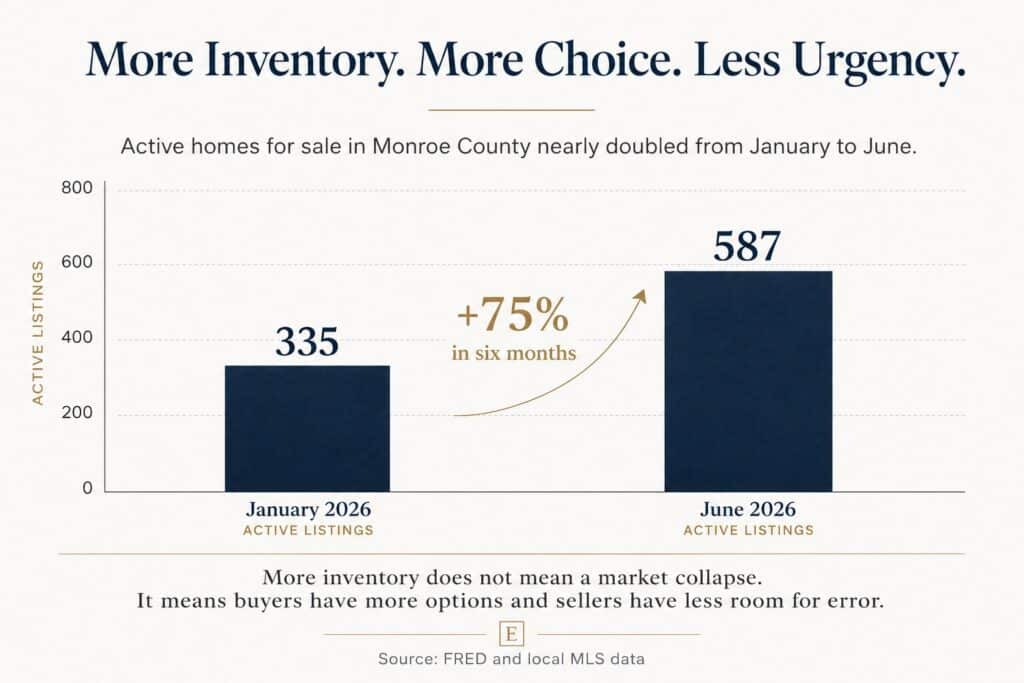
Meanwhile, according to FRED data, there were 335 homes available for sale in Monroe County in January. That number has risen dramatically and, according to the MLS, now sits at 587.
As the number of homes for sale has increased and buyers have become more cautious, the pace of appreciation has slowed. Zillow forecasts that Rochester home values will increase 3.4% in the coming twelve months. That is still appreciation but, yes, it is a far cry from the double-digit gains that defined much of the post-Covid market. Contextually, Rochester is currently ranked fifth among the cities Zillow expects to appreciate most- a small cause for celebration.
Given the insanity of the market these past six years, it’s easy to question whether today’s conditions signal distress. In reality, this is simply a more traditional market- similar to that which we experienced for decades- one that is both slower and more stable. Regrettably, this nuance is lost on many agents, especially those who have only been selling since the onset of the pandemic.
Looking more closely at the dynamics, it’s obvious that the local real estate market is increasingly bifurcated. The first market is comprised of those properties that have been well-cared for, staged beautifully, located in a good school district, and priced appropriately. These homes are still commanding top dollar; perhaps not multiple offers resulting in a sale $100,000 over asking but they will capitalize on the increase in value from the past few years and, perhaps, more. The other market is made up of homes whose owners believe that the conditions which defined real estate sales in 2023 still prevail today. These sellers haven’t kept the property in good condition and feel no need to prepare the home for sale. This mindset often means that these houses are overpriced causing them to sit on the market before the price is reduced or, occasionally, delisted.
This is not a market in free fall. It is a market finding a more sustainable cadence. And while no one can say with certainty what the next twelve months will bring, Rochester remains better positioned than most places in the country. The strongest sellers will be those who recognize that the ride has changed. Knowing when to adjust is what separates a good ride from a great one.
Prefer to listen?