

Rochester NY - Market Update - December 2025
by: Mark Siwiec
Rochester is Surging While the Nation Slips: The Market Shift You CAN'T Ignore!
A few days ago, I celebrated my favorite holiday- Thanksgiving. It’s an incredible opportunity to slow down and give thanks- surrounded by those you love most in the world. As is always the case, I have a lot to be grateful for, and this year was no exception. This November, my litany of good fortune included a late entry- one delivered by realtor.com a few days before I piled on several large helpings of mashed potatoes and stuffing. Turns out that home values in Monroe County have increased 75% since 2019, the seventh-highest appreciation rate in the country. In a national market currently rife with volatility and decline, that’s a trend worth giving thanks for.
As the year winds down, Rochester’s performance stands out not only for its strength but for how sharply it contrasts with what’s unfolding across much of the United States. Zillow’s latest forecast projects that our region will see a 2.6% increase in home values over the coming year. It’s modest compared with the extraordinary growth of the past six years, but in a national landscape where 105 of the 300 largest metros are now posting price declines, modest becomes meaningful. Rochester isn’t slowing. It’s stabilizing. And stabilizing at the top of the field is something most cities would envy.
Thanks to its relative affordability, quality of life, and measured pace of growth, Rochester is outperforming both regional and national trends. While much of the Sun Belt is doing its best to recover from its pandemic-era banger, the Northeast and Midwest remain anchored by tighter inventory and steady demand.
Understanding why Rochester continues to shine requires stepping back to look at the forces now reshaping the national market. The American housing market is not in a boom or a bust- it’s in a freeze. And that freeze is driven by demographics, economics, and supply conditions all converging at once.
Start with mobility, or rather, the lack of it. According to Redfin, only 28 out of every 1,000 homes changed hands this year- roughly 2.8% turnover, the lowest rate in more than three decades. Millions of Americans are locked into mortgages below 4% and have no financial incentive to sell. When homeowners don’t move, inventory doesn’t refresh, and markets don’t rebalance. Scarcity becomes not a temporary condition but the defining feature of the market.

Demographics deepen that stasis. Sixty-one percent of Baby Boomers say they do not plan to sell their homes. This is the largest, most asset-heavy generation in American history, and their decision to age in place removes millions of units from circulation.
Meanwhile, younger generations are being squeezed into a narrower window of opportunity. The median age of a first-time buyer is now 40, up from the late 20s a generation ago. And the share of first-time buyers has collapsed to 21%, the lowest number ever recorded. Millennials are finally buying- but later, with more debt, and with more competition. Gen Z appears on track to follow the same delayed trajectory.
These aren’t separate trends- they’re all chapters of the same story. An aging generation staying put, a younger generation entering late, and a nation of homeowners locked into historically low mortgage rates have created a level of structural immobility we have never seen before. The market isn’t cycling. It’s calcifying.
Could new construction break the logjam? Not in the near term. The country needs roughly 440,000 additional construction workers each year just to meet baseline demand. Material costs are up 41.6% since the pandemic. Construction expenses rose 5-7% this year. And local, state, and federal regulatory barriers continue to slow timelines and raise costs. Builders are building- just nowhere near the levels required to meaningfully expand supply.
And yet, even in the middle of this supply-driven crisis, national policy continues to focus on the wrong levers. The recently proposed 50-year mortgage offers the illusion of affordability while stretching debt nearly across a human lifespan. With the median first-time buyer now 40, such a product would mean paying off a mortgage at age 90. That isn’t a pathway to ownership- it’s bank-sponsored servitude. Thankfully, most bankers that I’ve spoken to agree that this is a ridiculous policy; a single aspirin offered to a patient on life support.

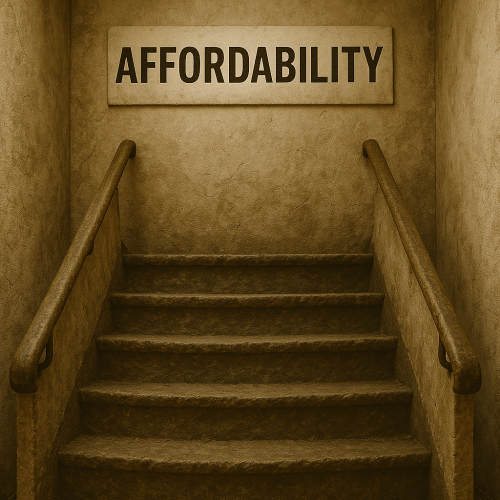
All this stability, however, comes at a cost. The same scarcity that keeps Rochester’s housing values strong also makes it harder for many potential homeowners- especially first-time buyers- to enter the market at all. When inventory remains tight and prices remain elevated, younger buyers’ risk being shut out of one of the most reliable on-ramps to long-term financial security in American life: homeownership. The housing market may be structurally sound, but its point of entry has become narrower, steeper, and increasingly delayed.
As we move into the final weeks of the year, there is genuine gratitude to be found in the strength of this region’s housing market. But gratitude isn’t complacent. The task now is to ensure that the future reflects the same stability, and that the path to homeownership remains open to the generations who will carry Rochester forward. Achieving that will require coordinated action from federal, state, and local governments- zoning reform, down payment assistance programs, and enhanced tax benefits for builders that make construction financially viable again. With any luck, next year we’ll have reason to celebrate that meaningful steps are finally taken.
If you have any questions or concerns about real estate, please don’t hesitate to reach out.
 Call me at (585) 330-8750
 Email me at mark@elysianhomesny.com
 Visit us at elysianhomesny.com