
From Buffalo to Rochester: The Roots That Shaped Me as a Real Estate Broker
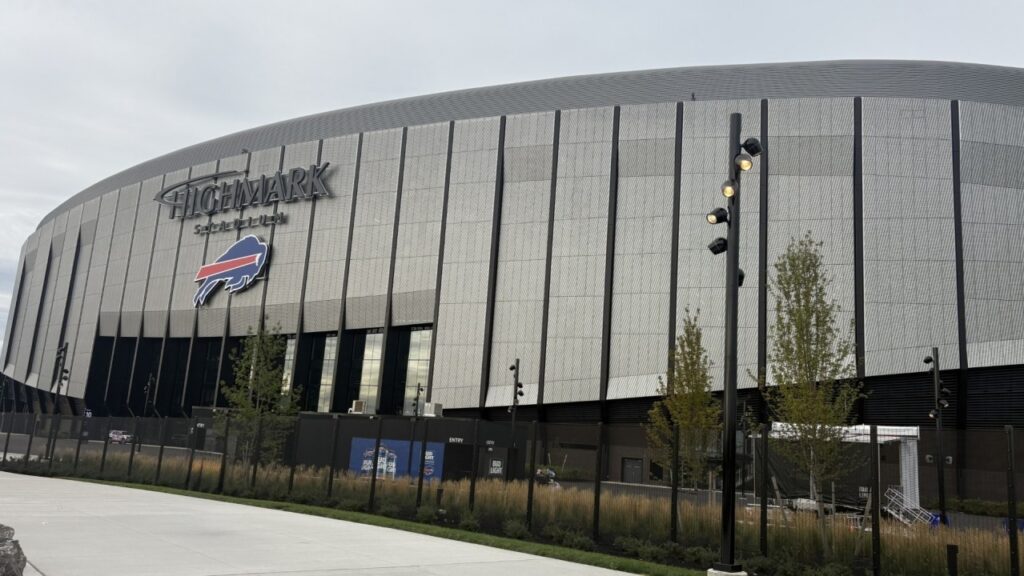
Oh my god, I thought. It’s actually more beautiful in person than it appeared when I saw it on television Thursday night. Obviously, any structure costing $2.2 billion is going to capture your attention. However, in a part of the country bereft of large-scale construction for decades on end, Highmark Stadium makes an even greater impression than a similar structure erected in some high-wattage, building-saturated metropolis like New York or Los Angeles.
As I approached the entrance, I remember thinking that Buffalo actually feels like a big city. The sophisticated design, the engineering, sightlines, acoustics, and technology were as over-the-top as one might expect. It was something much more mundane that actually caught me by surprise. Looking outward from a second-floor concourse, I immediately saw Lake Erie. Why I was slightly taken aback, I’m not sure. After all, I grew up not more than a ten-minute drive from Rich Stadium and the lake was part of my daily existence. What I was reacting to was the fact that, not far off, I could visualize the contours of my old neighborhood. As I did, I sensed the slightest inhalation- not quite a gasp, but nevertheless, a moment. It had been a long time…
Seeing Buffalo’s Past from Its New Stadium
Reclaiming my breath, I recognized that, looking north, I could spot Buffalo’s remarkable skyline. In the foreground was the structure that I still refer to as the HSBC Building. And, behind it, the Art Deco palace that is City Hall. I distinctly remember driving through Niagara Square as a six-year-old, shocked at how beautiful the newly painted building was. What had been an enormous, black edifice had been transformed into a spectacular cinnamon-hued confection. It was astonishing.
What was even more remarkable was the backstory; my mother told me that the soot and grime from Bethlehem Steel had actually sullied this architectural masterpiece, cloaking it in the expectorant of coke ovens, furnaces and locomotives. It was as a result of high-pressure power-washing that the original limestone was finally scrubbed, revealing the monument’s inherent beauty. In retrospect, the timing seemed almost intentional. As the age of steelmaking was coming to an end, community leaders were preparing for the area’s next chapter by bathing and then unveiling its incredible civic landmark.
As I refocused my attention, I was drawn from the skyline in the distance to a sound more immediate. Across the road from the Buffalo Bills’ new home, another era was coming to an end. A phalanx of tractors, backhoes, and dump trucks was dismantling what had been the football team’s aged, weather-beaten colossus for more than fifty years. Some structures can be retrofitted, cleaned and burnished to face a new day. Others need to be demolished in order to make way for the new. I’ve actually been both.
Finding My Way from Buffalo to Rochester
Back in 1983, I drove east along the New York State Thruway for seventy-five miles, settling into my dorm room at the University of Rochester. I was a brash kid who, thanks to a genetic roll of the dice, had potential. Unfortunately, something kept getting in the way and I couldn’t quite identify why I wasn’t able to navigate the streets and corridors of this new city. My understanding began to crystallize when I realized that, unlike Buffalo, there wasn’t a Catholic Church or a bar on every other street corner. This place was different. As my aspirations continued to outpace my trajectory, I became more self-aware. Rochester’s social code and rules of conduct were written by and for a different class of people. I don’t use the word “class” to imply that one was better than the other. We were simply shaped by different assumptions about how people spoke, socialized, and made their way through their days.
For instance, as a newly licensed driver in Buffalo, I remember being pulled off of the road and into a snowbank during a light winter storm. Without fear or concern, I turned on my flashers and, sure enough, the next three cars stopped and pushed me out of danger. This is a blue-collar town in which an unspoken contract exists between its citizens. The region’s harsh winters and the meager wages paid to steelworkers mandated that the community band together. Regardless of the strength of one’s personal determination and grit, there was strength in numbers.
The Steel Core That Remains
Back at the stadium, I turned my gaze back to Summerway Lane. It was hard not to think about distance- both physical and temporal- and things began to fall into place. Here I was, a 61-year-old, willful real estate broker whose sharp elbows are, perhaps, a bit softened. Education and experience have imbued my writing and conversation with an impressive vocabulary- or, at least, one that I feel can occasionally pass for impressive. My upbringing, however, insists on announcing itself by coarsening my language with far too many profanities and four-letter words.
In order to learn to navigate the byways of Rochester and become the man that I am today, it was necessary to discard some of who I was. Self-reflection, trial and error, and the hard lessons to be learned from conflict and disappointment washed away some of the soot and the grime.
The drive, the will, and the determination—the steel core—remained.
Standing inside Buffalo’s new stadium, I understood that core a little differently. Its steel is what allows the structure to stand today and withstand whatever comes next.
Mine will do the same.